
A Focus on Flexibility
When ESCAPE researchers submitted their grant proposal to the National Science Foundation (NSF) for the Center, they wanted to include a mechanism that would allow some funding to be set aside for future projects that would benefit the Center’s mission, but that hadn’t been thought of at the time of submission. The mechanism that they designed is called the Challenge Oriented Multidisciplinary Problem-Solving grant, otherwise known as the CHOMP grant (we had to get a little creative with the acronym too). Since the grant was for seven years of funding, ESCAPE researchers understood that they couldn’t possibly foresee every possible project that might come up, so the CHOMP grant was designed to give the Center some leeway to identify gaps in its approach to environmental surveillance over the life of the Center and dedicate resources to filling in those gaps.
Work on one of the Center’s early CHOMP awards, a project known as the Health and Wildlife Knowledge (HAWK) database, recently concluded, and we’re excited to tell you about it.
The Gap
Environmental surveillance data is highly decentralized, often not shared publicly, and awash with highly technical non-standardized jargon without semantic compatibility, limiting its utility to both public health practitioners and the public. To enhance environmental surveillance data’s value as a public health tool, all these data practices need to be resolved. Establishing a new culture for environmental surveillance data management and their accessibility is an important component of ESCAPE’s mission. Constructing a purpose-built database for environmental surveillance data would be tremendously time consuming, expensive, and technically difficult. Rather than going down that path, the ESCAPE team felt like it might be possible to retrofit an existing product to accommodate environmental surveillance data. The HAWK database was brought to attention by one of our Center’s key partner organizations, the Wildlife Conservation Society (WCS).
HAWK is a product in development initially funded and built by WCS as a means for standardizing and centralizing data entries related to health surveillance in wildlife and animal samples used for a variety of purposes. The metadata already collected by HAWK (geocoordinates of sample location, sample type, outcome of diagnostics, etc.) seemed to lend itself well to expansion into the realm of environmental surveillance, so ESCAPE decided to dedicate some funding to exploring that possibility. As a pilot project, the goal of the research was simply to incorporate a few new elements to the HAWK data model and assess the feasibility of expanding its functionality to include environmental surveillance data as well.
The HAWK Database and ESCAPE
HAWK’s developer, Dr. Diego Montecino-Latorre, spent the past year assessing the program’s potential for management of the environmental surveillance data from ESCAPE. He felt that the program offered several key advantages:
- secure storage of homogeneously structured environmental surveillance data,
- centralized access from a single location,
- governed by user-specific permissions, and
- a clearly defined common terminology
Then he got to work adapting the database to meet ESCAPE’s needs, adding environmental specimens to the list of sources, new sample types, and new on-site diagnostics for environmental sources (e.g., water stream) and samples (e.g., tests in the lab). Since several additional fields were needed for environmental samples that weren’t necessary for wildlife samples, Dr. Montecino-Latorre worked closely with ESCAPE researchers to identify the fields that would be necessary for the program to be useful for their purposes.
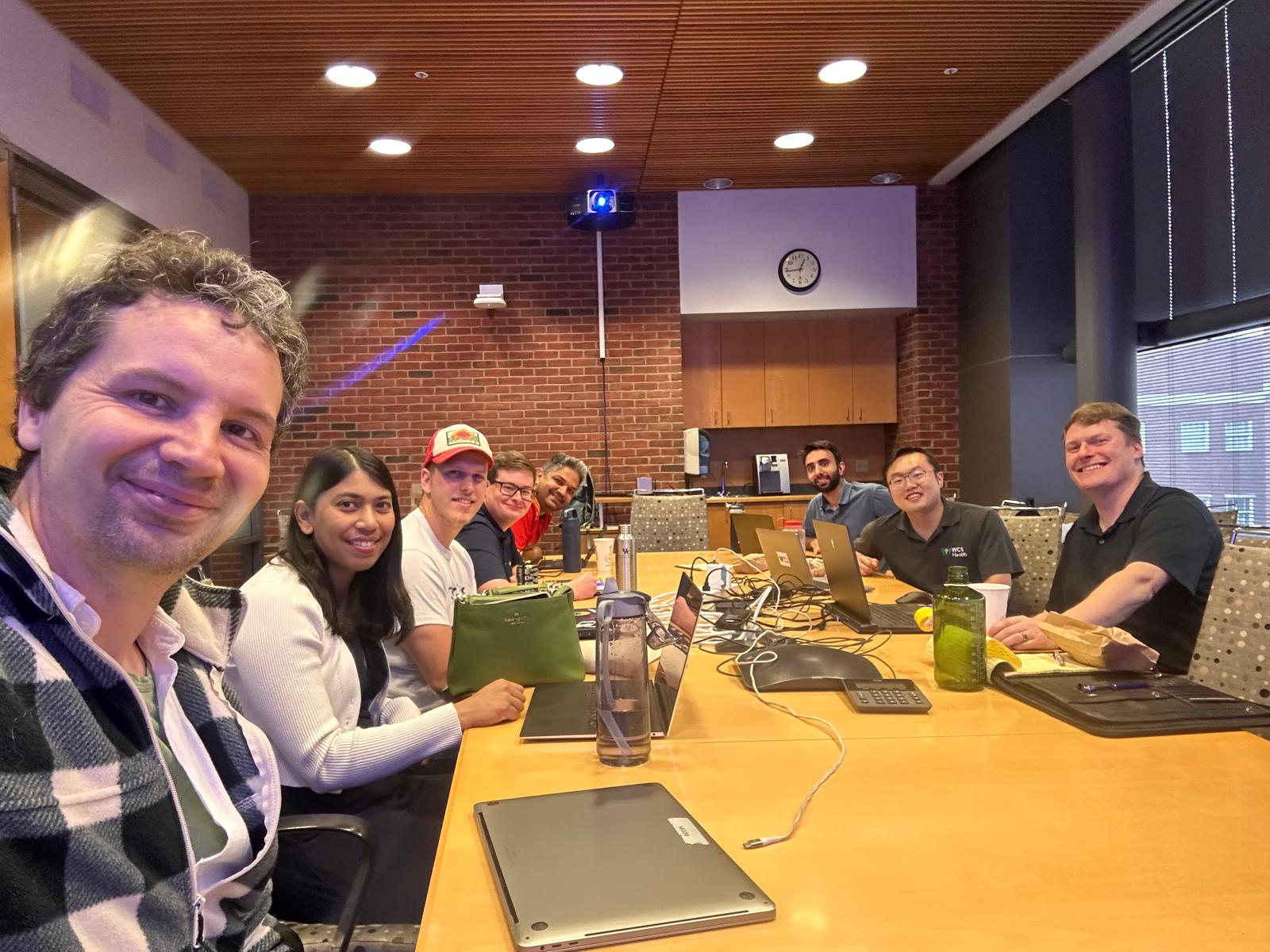
Researchers were granted permissions to the database and given extensive training back in July on the use of the system. Dr. Montecino-Latorre solicited feedback from team members about the HAWK workflow to assess whether it would satisfy the Center’s needs. He used this feedback to aid in the further development of the database. ESCAPE researchers came to an agreement on the different data that should be tracked, including extraction data quality assessments, library preparation quality preparation, etc., but it was determined that metagenomics data was too complex to be included in the initial rollout.
Lessons Learned
The HAWK database adaptation and training process was highly beneficial to identify areas of improvement for ESCAPE data management practices and identify what HAWK’s GUI needs to be able to do to be well suited for expansion into the realm of environmental surveillance. WCS intends to upgrade HAWK’s GUI to include the structure, fields, and further functionalities identified because of the CHOMP award findings. Despite its potential, ESCAPE simply doesn’t have the financial resources necessary to fully upgrade the system to the point where it would be ideal for environmental surveillance data. As a proof of concept, the experiment was successful, even if the product isn’t ready for wide scale environmental surveillance implementation. ESCAPE will continue to work with WCS to lend its expertise to the further development of the HAWK database and explore the possibility of its adoption at later stages of development.